
Engineering Project
Florida Tech — WFIT Transmitter Room Expansion
- Melbourne, Florida
- 350 SF
- Data Centers / Higher Education
- Mechanical + Electrical + Plumbing
Project Overview
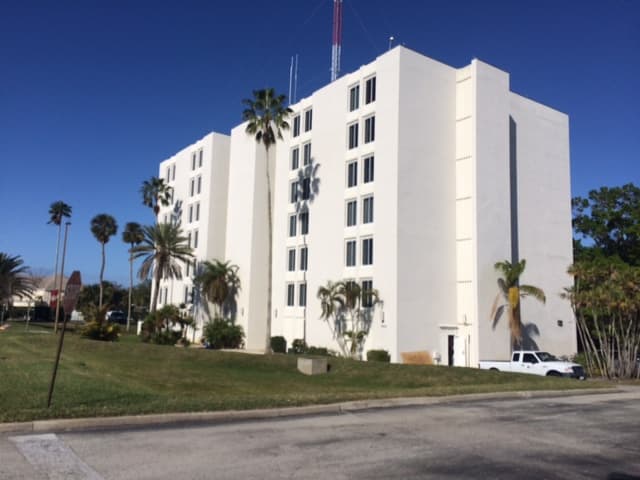
The WFIT transmitter room occupies 350 square feet on the seventh floor of Roberts Hall at Florida Institute of Technology in Melbourne, Florida. The room houses the transmitters that generate radio waves for the station antennas on the roof of the building. BEED Engineering provided MEP engineering design for a transmitter room expansion.
A transmitter room is a small floor plate with mission-critical heat, power, and fire protection. The engineering had to keep the radio equipment cool and powered, suppress fire without water damage to electronics, and reach weatherproof electrical gear associated with the rooftop antennas.
The Challenge
Radio transmitters reject heat continuously and cannot tolerate an ordinary office HVAC or power arrangement. The room is on the top floor of Roberts Hall, directly below the antenna farm, which shortens the path to the roof but leaves little space for equipment.
The expansion had to:
- Provide rooftop HVAC and controls sized for transmitter heat, not occupant comfort alone
- Include uninterruptible power and an automatic transfer switch so the transmitters could ride through a utility interruption
- Provide FM-200 fire suppression instead of a wet sprinkler approach over electronic equipment
- Coordinate weatherproof non-fused disconnects with the rooftop antennas
- Fit lighting and receptacles into a 350-square-foot room already occupied by transmitters
Those requirements are closer to a small data or network room than to a typical campus renovation, which is why the project sits with BEED’s data-center and specialized work as well as its Florida Tech laboratory projects.
BEED Engineering's Scope
BEED provided MEP engineering design, including:
- Mechanical engineering for the rooftop HVAC system and HVAC controls
- Electrical engineering for UPS, automatic transfer switch, weatherproof disconnects, lighting, and receptacles
- Fire suppression (FM-200) as part of the engineered building systems
- Plumbing engineering as part of the MEP assignment
Project administration was not listed as part of this scope.
Engineering Solutions
A rooftop HVAC system with dedicated controls serves the transmitter room so cooling can track equipment load. FM-200 fire suppression protects the space without putting water on the transmitters. Electrical design includes a UPS, an automatic transfer switch, weatherproof non-fused disconnects for rooftop equipment, surface-mounted light fixtures, and duplex receptacles.
The antennas remain on the roof of Roberts Hall. The expanded seventh-floor room is the conditioned, protected, and powered space that keeps those transmitters on the air.
Related BEED Services
Service
MEP Engineering
Coordinated mechanical, electrical, and plumbing engineering for commercial, healthcare, education, and institutional buildings.
Service
Mechanical Engineering
HVAC, chilled water, central plants, ventilation, humidity control, and building automation for commercial and institutional buildings.
Service
Electrical Engineering
Power distribution, lighting, generators, fire alarm, and low-voltage systems for new construction and renovations.
Service
Data Center Engineering
Cooling, power, and reliability design for data rooms and mission-critical facilities.
Related Locations
Related Resources
What Is MEP Engineering?
MEP engineering is the coordinated design of mechanical, electrical, and plumbing systems that make a building usable, safe, and efficient.
What Is HVAC Engineering?
HVAC engineering is the design of heating, ventilating, and air-conditioning systems that control temperature, humidity, ventilation, and indoor air quality.
What Is Electrical Power Distribution?
Electrical power distribution is the path from the utility service through switchgear and panels to the building’s lights, receptacles, and equipment.
How Do Commercial Generators Work?
Commercial generators start on a utility outage, produce electricity, and feed selected building loads through automatic transfer switches.
What Is Emergency Power?
Emergency power is the legally required backup source that keeps life-safety and other designated loads operating when normal utility power is lost.
Related Projects
BEED Engineering
Data Center
FPL Data Center
Daytona, Florida · Mechanical Engineering
Data Center
FPL Data Center
Daytona
Daytona, Florida
Mechanical Engineering
Mechanical engineering for an 8,000-square-foot data center in Daytona, Florida, with packaged HVAC, raised-floor air distribution, and FM-200 fire suppression.
View Project →
Higher Education
Florida Institute of Technology
Fume Hood Modernization
Melbourne, Florida
Mechanical + Electrical Engineering
Mechanical and electrical engineering for a 40,000-square-foot laboratory fume hood modernization at the Olin Physical Science Building in Melbourne, Florida.
View Project →BEED Engineering
Higher Education
Florida Institute of Technology
Melbourne, Florida · Mechanical + Electrical Engineering
Higher Education
Florida Institute of Technology
Link Building Fume Hood Modernization
Melbourne, Florida
Mechanical + Electrical Engineering
Mechanical and electrical engineering for a 25,700-square-foot laboratory fume hood modernization in the Link Building at Florida Institute of Technology in Melbourne, Florida.
View Project →Local Presence
BEED Engineering — Based in Palm Bay, Serving Central Florida
BEED Engineering is an MBE professional consulting engineering firm providing building mechanical, electrical, and plumbing (MEP) engineering design and consulting services. We are based in Palm Bay, Central Florida. BEED Engineering is a firm you can trust to get the job done.
Next Project
Have a Similar Engineering Project?
Talk with BEED Engineering about your next mechanical, electrical, plumbing, or mission-critical building systems project.